
How AI is Changing Go-To-Market Strategy in 2026
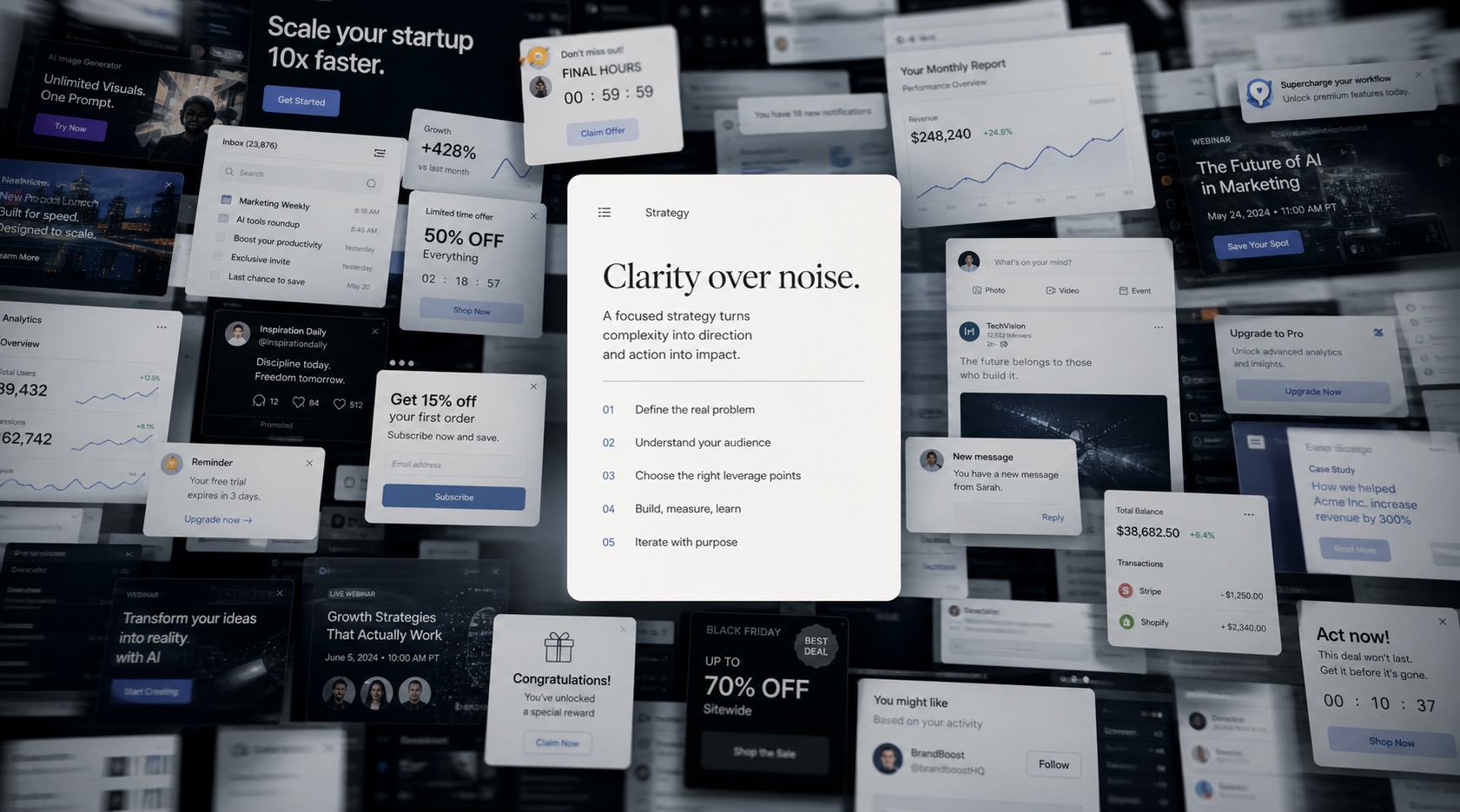
In 2024, Gartner predicted that generative AI would fundamentally reshape how businesses create, distribute and personalise marketing. In 2026, that shift is no longer theoretical. AI-generated content has become standard practice across industries, product development cycles are shortening, and buyers are now exposed to more messaging than ever before.
But while AI has made it easier for companies to produce output, it has also created a new problem: sameness.
Markets are becoming saturated with near-identical messaging, interchangeable product claims and increasingly commoditised customer experiences. The barrier to creating campaigns, landing pages, ads and even products has dropped dramatically. As a result, many companies are moving faster — but not necessarily becoming clearer.
This is beginning to reshape go-to-market strategy at a structural level.
The companies adapting successfully are not simply adopting AI tools. They are rethinking how they position themselves, how teams align around strategy, and how decisions move from planning into execution.
The Acceleration Problem
AI has compressed timelines across almost every commercial function.
Marketing teams can now produce weeks of content in hours. Product teams can prototype faster. Research that once took days can happen instantly. Smaller teams are able to operate at a scale that previously required significantly larger organisations.
On the surface, this looks like a major efficiency gain. In many ways, it is.
But acceleration introduces its own operational risks.
When organisations move faster without strategic clarity, they often amplify existing problems:
unclear positioning,
fragmented messaging,
disconnected priorities,
duplicated work,
and reactive decision-making.
The result is often an overwhelming amount of activity without meaningful differentiation.
Many businesses are discovering that AI does not solve strategic ambiguity. In fact, it tends to expose it faster.
Why Differentiation Is Becoming Harder
One of the most significant effects of AI is the rapid commoditisation of execution.
Good design is more accessible. Copywriting is easier to produce. Campaign structures are increasingly standardised. Even sophisticated marketing workflows can now be automated or replicated quickly.
This means competitive advantage is shifting.
For years, many companies relied on execution quality alone to stand out. Today, that advantage is shrinking. Buyers are seeing more polished content, more products and more messaging than at any point before — often saying nearly identical things.
The consequence is a growing “sea of sameness.”
Phrases like:
“customer-centric,”
“AI-powered,”
“streamlined workflows,”
“innovative solutions,”
have become so overused that they communicate almost nothing.
At the same time, buyers are becoming more selective and more sceptical. Especially in B2B markets, purchasing decisions increasingly depend on clarity, trust and specificity.
Companies that cannot clearly articulate:
what they do,
who they are for,
why they matter,
and how they are different,
are finding it harder to compete — regardless of how much content they produce.
The Shift From Content Volume to Strategic Clarity
For years, growth strategies heavily rewarded volume:
more campaigns,
more content,
more channels,
more automation.
AI has accelerated this model to its logical extreme.
The problem is that audiences are now overwhelmed by low-friction marketing. Visibility alone is no longer enough. The companies gaining traction are often those with stronger strategic coherence rather than simply higher output.
In practical terms, this means:
clearer positioning,
tighter messaging,
stronger internal alignment,
and better operational focus.
The organisations adapting best to AI are not necessarily publishing more. They are communicating more precisely.
This requires a shift in how companies approach go-to-market strategy.
Instead of asking:
“How do we produce more efficiently?”
The better question is:
“How do we create clarity across the organisation so execution becomes more effective?”
That distinction matters.
Because many go-to-market problems are not marketing problems at all. They are alignment problems.
Why GTM Alignment Matters More Than Ever
As businesses scale, go-to-market functions naturally become more complex.
Marketing, product, sales, customer success and leadership teams all influence how a company presents itself to the market. Without strong alignment, these teams often operate from slightly different assumptions:
different priorities,
different interpretations of the customer,
different definitions of value.
Under normal conditions, this creates friction.
Under accelerated AI-driven conditions, that friction compounds quickly.
Teams begin shipping faster than they are aligning. Messaging drifts. Priorities shift constantly. Campaigns become disconnected from product reality. Internal confusion eventually becomes external confusion.
This is one of the reasons many companies feel increasingly busy while struggling to maintain strategic focus.
A modern go-to-market strategy cannot simply be a marketing plan. It needs to function as an operational framework that connects:
positioning,
prioritisation,
execution,
and organisational decision-making.
Without that structure, speed becomes noise.
What Companies Should Be Doing Differently
The organisations adapting successfully to this new environment tend to share several characteristics.
1. They prioritise clarity before scale
Rather than immediately expanding channels, content or tooling, they first ensure the organisation has alignment around:
target audience,
positioning,
strategic priorities,
and core messaging.
This creates consistency across execution.
2. They reduce operational complexity
Many companies are currently over-operating:
too many initiatives,
too many campaigns,
too many priorities running simultaneously.
AI makes it easier to create more work. It does not automatically make organisations more focused.
Successful teams are becoming more disciplined about prioritisation and operational structure.
3. They connect strategy to execution
One of the biggest gaps in many organisations is the translation layer between leadership vision and day-to-day execution.
Strategies often exist in presentations, while delivery teams operate in completely different realities.
Companies adapting well are investing more heavily in:
cross-functional alignment,
operational planning,
clear ownership,
and measurable execution frameworks.
4. They focus on differentiation beyond features
As products become easier to replicate, differentiation increasingly comes from:
clarity,
customer understanding,
strategic narrative,
operational experience,
and trust.
This requires deeper strategic work than simply optimising campaigns.
The Future of Go-To-Market Strategy
AI is not replacing go-to-market strategy. It is making strong strategy more important.
The companies that succeed over the next few years are unlikely to be those producing the highest volume of output. They will be the ones that create the strongest alignment between:
market positioning,
organisational focus,
and operational execution.
In many ways, AI is forcing companies to confront a question that already existed:
Does the organisation actually know what it is trying to achieve — and can it execute consistently against it?
Technology can accelerate execution. But it cannot create clarity on its own.
That work still requires strategic thinking, operational structure and organisational alignment.
And as markets become faster, noisier and more commoditised, those capabilities are becoming increasingly difficult to ignore.
